
StreamGPT Platform
Stream’s AI Agent Platform lets organizations deploy AI assistants securely within their own infrastructure, using company knowledge to improve productivity, decision-making and operational efficiency.
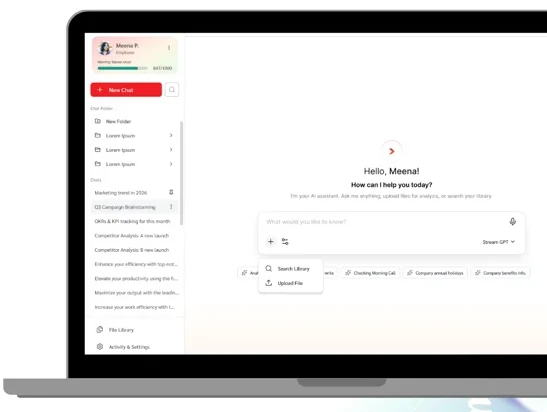
StreamGPT is Stream’s product for organizations that want AI assistants working on their internal data and knowledge, while users, access rights, policies and audit logs stay under the organization’s own control.
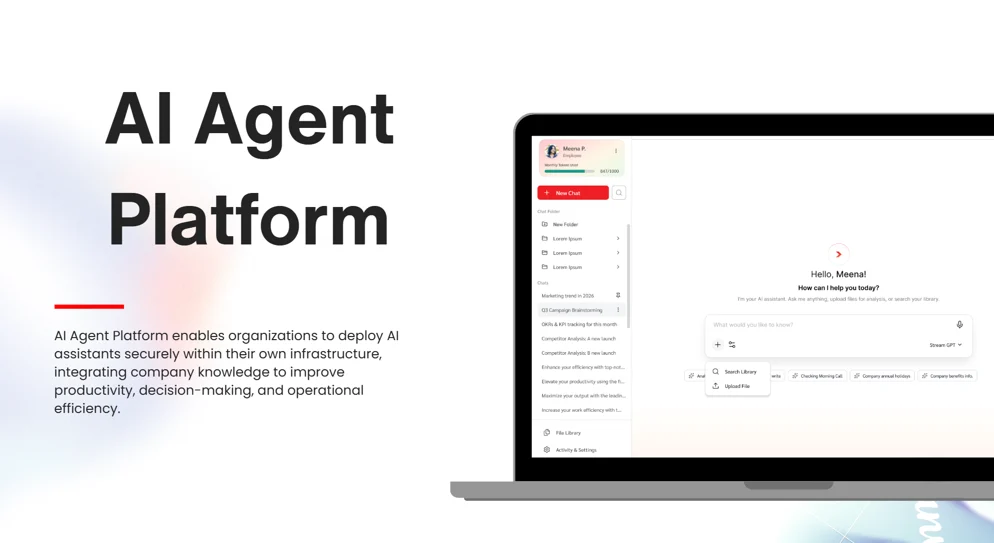 StreamGPT user workspace — chat, search the file library, and upload files for analysis
How it works
Load knowledge sources
Documents, policies and approved FAQs are organized in a central knowledge base
Configure AI personas
Departmental assistants (HR, Finance, Legal, IT) get their own prompts and knowledge
Ask in plain language
RAG retrieves from internal documents so answers are grounded in trusted data
Govern and audit
Role-based access, usage monitoring and audit logs under your policies
These steps are arranged from the existing content of this page.
Core capabilities
Internal Knowledge Assistant
- Internal knowledge assistant — helps employees quickly access internal knowledge, documents and organizational policies through natural-language queries.
- Accurate knowledge retrieval — StreamGPT retrieves relevant information from internal documents using Retrieval-Augmented Generation (RAG), so responses are grounded in trusted company data.
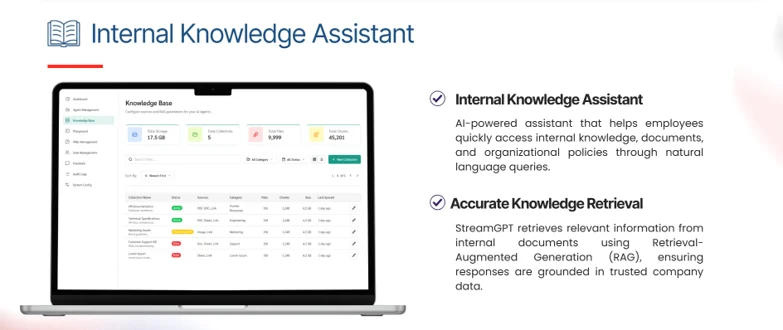 Knowledge Base — manage document collections and knowledge sources for AI agents
FAQs Management
- Centralized FAQ repository — manage and organize frequently asked questions in one system for consistent answers across the organization.
- Verified & updatable responses — maintain approved answers that can be easily updated to stay accurate and aligned with company policies.
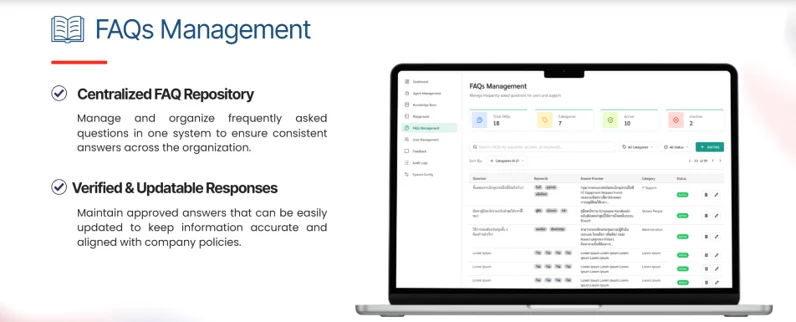 FAQs Management
AI Persona & Agent Management
- Custom AI personas — create specialized AI assistants for departments such as HR, Finance, Legal and IT, each with its own knowledge and response behavior.
- Agent configuration & control — manage and deploy AI agents for organizational tasks, adjusting prompts, knowledge sources and operational settings.
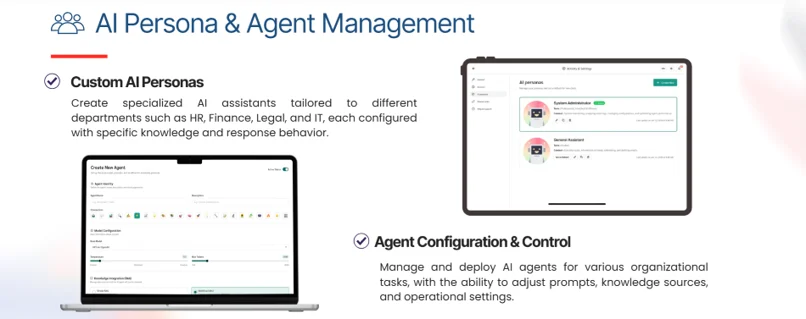 Creating and managing AI personas / agents
Enterprise Governance
- User & access management — control user roles, permissions and access levels for secure, appropriate use of AI across the organization.
- Usage monitoring & audit logs — track system activity, monitor AI usage and keep audit logs for transparency and compliance.
- Policy & system configuration — manage system settings, security policies and operational parameters (for example automatic masking of personal data, content-filtering level and log retention) in line with organizational governance standards.
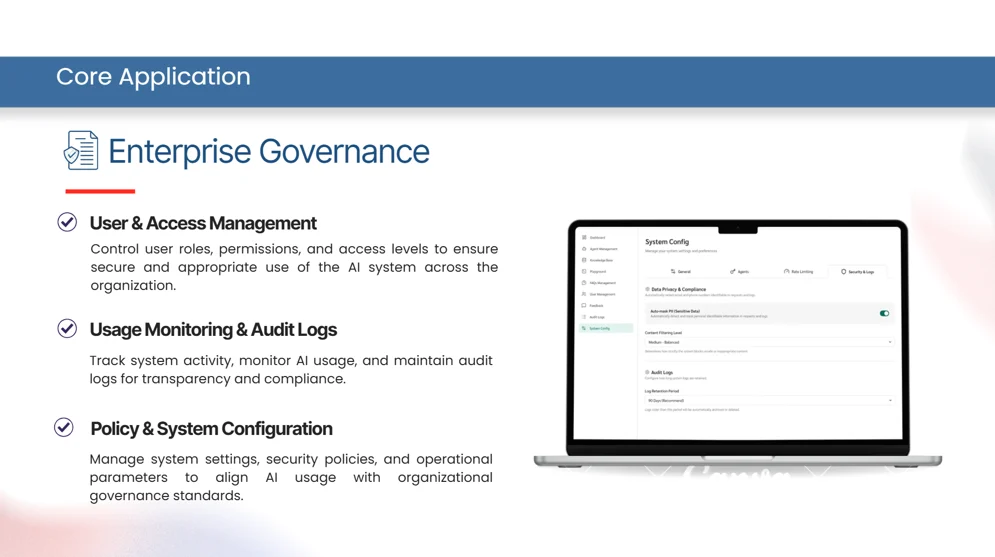 System Config — Data Privacy & Compliance and Audit Logs
Enterprise architecture
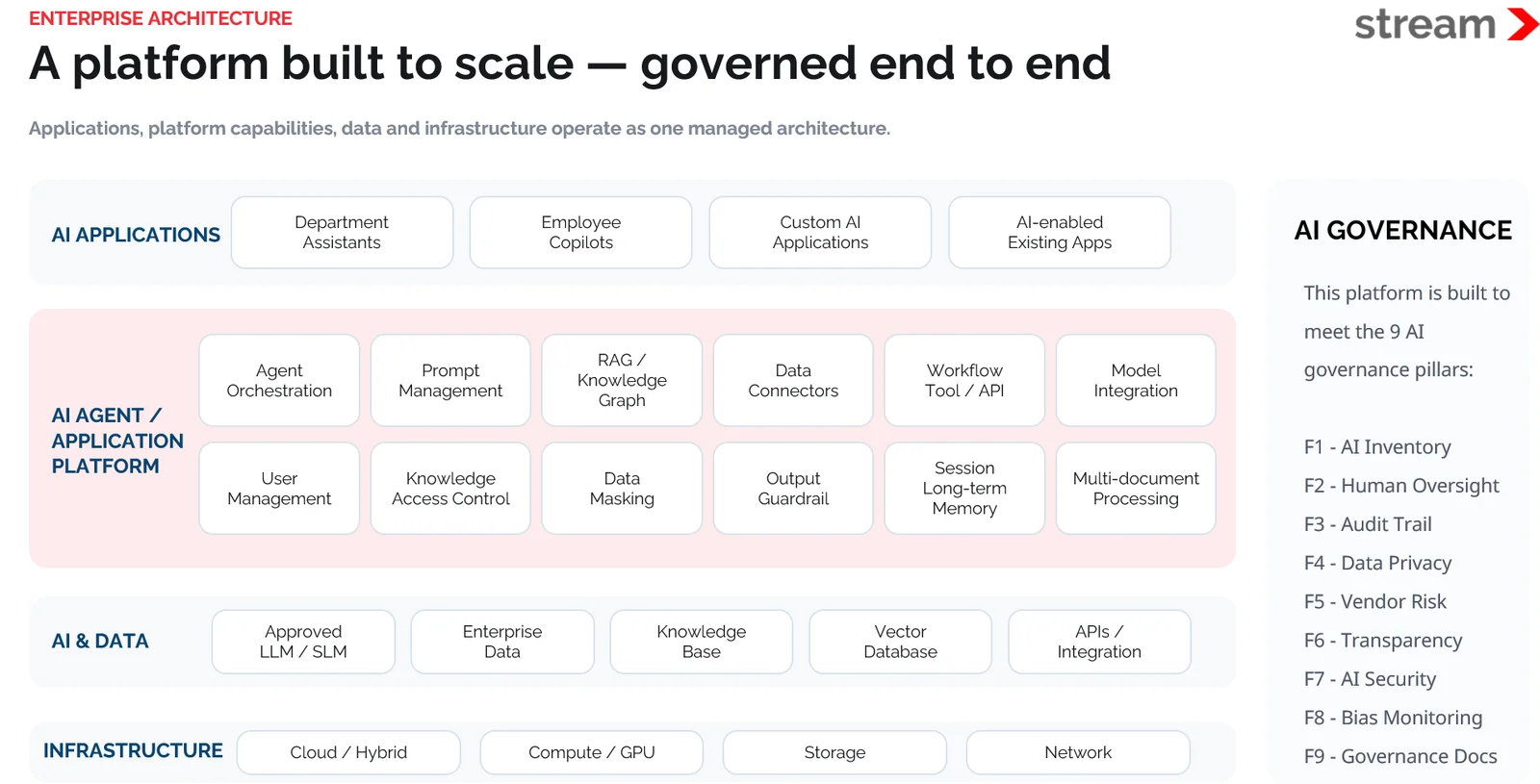
Applications, platform capabilities, data and infrastructure operate as one managed architecture, built to meet 9 AI governance pillars (F1–F9).
See the architecture diagram →
Who it is for
- Organizations that want employees to use AI on internal knowledge while data stays in infrastructure they control
- Teams that need departmental assistants for HR, Finance, Legal or IT
- Organizations that require access control, an audit trail and enforceable AI-usage policies
A platform built to scale — governed end to end
View original diagram
More use cases
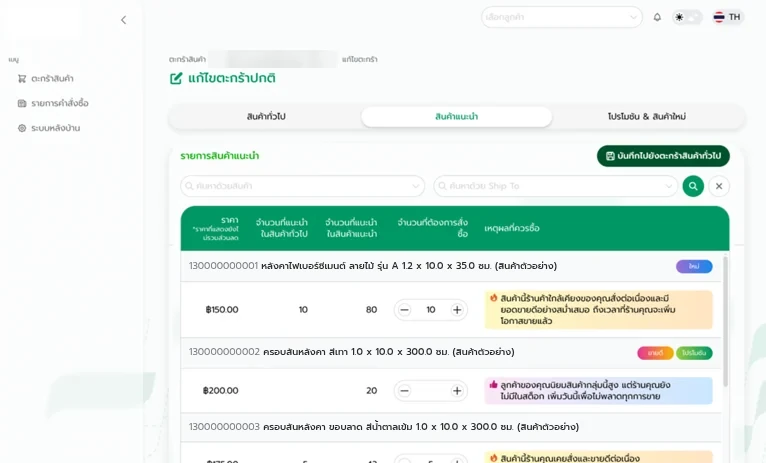
AI Order Recommendation
An app for brand owners and manufacturers: AI analyzes historical and contextual data to recommend the right products and quantities to sales reps and dealers, with pricing, stock checks and truck-load planning.
View use case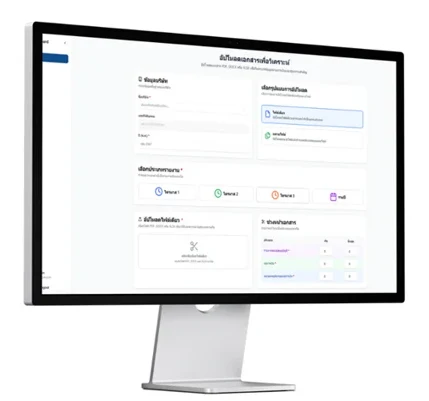
AI Financial Report Analysis
AI that analyzes financial statements, financial-status risk, statement accuracy, consistency with the auditor’s report and 3-year business trends — built by Stream for a regulator, specifically for supervision.
View use case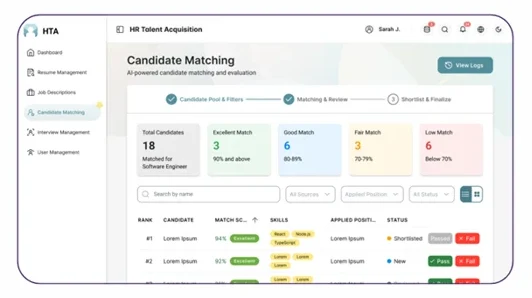
AI Talent Acquisition
AI for HR and recruitment — generate job descriptions, analyze resumes, rank and score candidates, match candidates to positions and generate interview question sets per position.
View use case