
AI Credit Decisioning with Alternative Data
AI across the credit lifecycle: instant pre-qualification, credit scoring with alternative data and explainable reasons, and AI agents that offer alternative credit options, handle limit increases and flag risk early, so banks decide faster, reach more customers and keep risk under control. Partner: VeriPark. Designed for leading commercial banks.
Many customers, such as micro-entrepreneurs, freelancers and young adults, have little or no credit-bureau history (thin-file), so traditional credit assessment struggles to judge them. AI Credit Decisioning with Alternative Data combines AI with consented alternative data, and uses AI agents that work alongside staff (human-in-the-loop) across the credit lifecycle: before the application, during the decision, and through portfolio management and collections, all within the bank’s credit policy.
Status: being proposed to a leading commercial bank together with solution partner VeriPark (AI-enabled loan origination and CRM)
How it works
Pre-qualify & apply
A chatbot pre-qualifies instantly; the customer then applies and consents to data use
Gather data
Internal, bureau and alternative data is gathered, quality-checked and turned into features
Score with reasons
The model scores risk with reasons; the decision engine applies credit policy
Decide & offer options
Low-risk cases are decided fast, judgement cases go to an officer, and customers who decline get alternatives
Monitor & warn early
AI agents watch for early warnings, support collections and feed outcomes back into the model
These steps are arranged from the existing content of this page.
The challenge
- Thin-file and new-to-credit customers are declined or offered low limits, even when many of them can repay
- Manual assessment is slow and inconsistent, while customers expect fast digital approval
- Customers who decline an offer or are declined often drop out, and the bank never learns why or offers a better-fitting alternative
- Early-warning and collections work still relies on fixed rules that miss each customer’s context
- Risk models must be explainable, auditable and compliant with regulatory expectations and PDPA
Stream’s approach
- Combine many data sources: the bank’s own data (deposits, transactions, product history), credit-bureau data and consented alternative data such as bill-payment behaviour or e-commerce data for merchants
- Machine-learning risk models with explainable AI that show which factors drove each customer’s score, so credit officers can understand and explain the outcome
- Decision engine that combines model scores with credit policy to set approval, limit and terms, with human review where judgement is needed
- AI agents across the credit lifecycle: role-based agents such as Underwriting & Portfolio and Early Warning & Collections, each made up of several task-based agents
- AI-enabled loan origination from partner VeriPark, covering auto, personal and home loans, credit cards, commercial loans, scoring and servicing, and a digital lending portal
- Model risk management: performance monitoring, drift and bias detection, and documentation for audit
Example AI agents in lending
- Instant pre-qualification: a mortgage or auto-loan chatbot gathers the details it needs, fills gaps, and sends structured data to the decision engine for a real-time, non-binding loan recommendation
- Point-of-sale pre-approval: a time-limited, pre-approved financing offer before the customer goes shopping, through conversational AI
- Smarter credit-limit increases: when a customer turns down a limit increase, the agent explores why, explains the benefits and offers better-fitting alternatives, such as a smaller increase or a later review, within policy
- Alternatives after a declined offer: understands the concerns of customers who decline a loan offer and presents other pre-approved options
- Routing silent accounts: detects non-responsive delinquent customers and hands them to staff with a context-rich summary
- SME lending: alerts on covenant breaches and early warning signs, offers grace periods when short-term financial stress appears, and prompts renewals of loans nearing maturity
Benefits
- Wider access to credit for customers the old process could not assess, with risk kept under control
- Faster, more consistent decisions
- Higher offer acceptance and customer satisfaction while staying within credit policy
- Earlier risk detection and better recovery while preserving the customer relationship
- Explainable, auditable decisions that support model governance and PDPA
- Credit officers can focus on complex cases
Who it is for
- Commercial banks and financial institutions growing retail, credit-card and SME lending
- Digital lenders that want responsible automated decisioning
More use cases
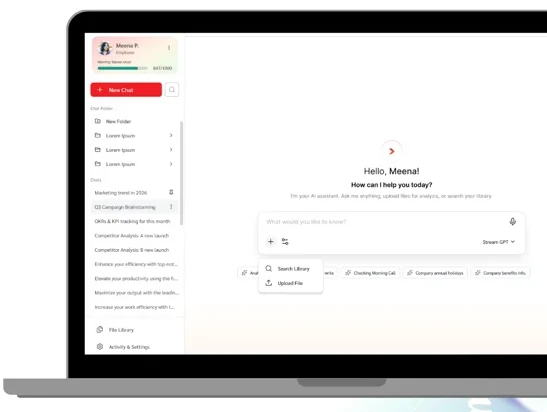
StreamGPT Platform
Stream’s AI Agent Platform lets organizations deploy AI assistants securely within their own infrastructure, using company knowledge to improve productivity, decision-making and operational efficiency.
View use case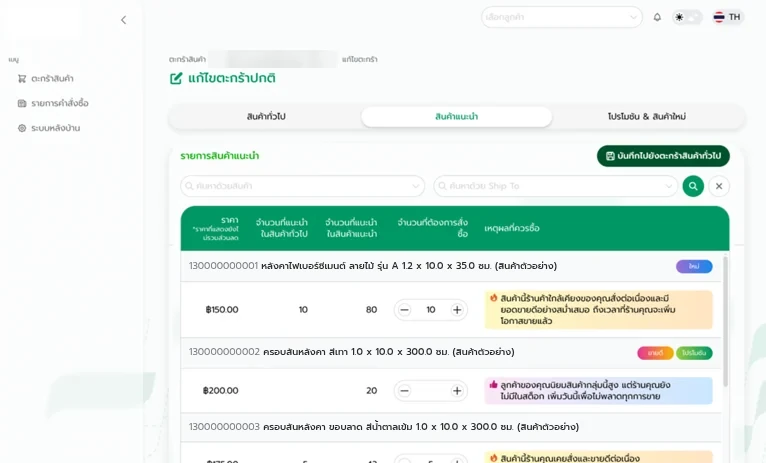
AI Order Recommendation
An app for brand owners and manufacturers: AI analyzes historical and contextual data to recommend the right products and quantities to sales reps and dealers, with pricing, stock checks and truck-load planning.
View use case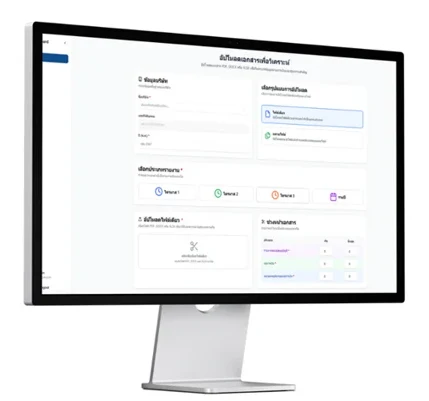
AI Financial Report Analysis
AI that analyzes financial statements, financial-status risk, statement accuracy, consistency with the auditor’s report and 3-year business trends — built by Stream for a regulator, specifically for supervision.
View use case